General Rules – Important (please read):
1- The usage of Artificial Intelligence (AI) tools (e.g. ChatGPT and other text or image/video generation tools) to assist in individual submission work is forbidden. Judges will be allowed to randomly check submissions using available detection tools to identify automatically created content (e.g. research or writing, photos, etc). Any identified AI-generated content will be disqualified from the competition.
2- No single individual can win more than 1 advanced competition category. If a participant is a winner in more than 1 competition, he will be declared a winner in the competition with the highest rank he qualified in, and his name will be among the top runner ups. This is to give chance to other participants. The exception is if a competition did not receive enough submissions, and so there are no other individuals qualify to be winners.
Advanced Level Competition: Arts
This is an advanced-level individual competition. The competition is open for all age groups. Enrollment and successfully competing in the core competitions is a prerequisite. This competition is intended to foster christian artistic creativity amongst Mahragan participants.
Guidelines and specific details:
- Choose one of the projects below and tie it to this year’s theme, Mahragan 2026 ”we are more than conquerors through him who loved us (Romans 8:37)”.
- Dry Media: Any two-dimensional work done with dry media such as pencil, pastel, crayon, charcoal, etc. or combination done on paper or other flat surfaces.
- Oil/Acrylic Painting: Any oil based or synthetic based (such as acrylic or alkyd) painting done on a two-dimensional surface such as canvas or hardboard (No Bristol Boards).
- Photography: Any image created using a camera, whether film or digital. Images must be printed on paper no smaller than 8×10 inches.
- Sculpture/Carving:Three-dimensional sculptural work created by carving or modeling.May be figurative or non-figurative. These kinds of projects must be sturdy, properly structured and able to free stand, the overall mark will be negatively affected if the structure is weak & flimsy.
- Wet Media Painting: Any water based media such as transparent watercolor, opaque watercolor, water based tempera or any combination of these done on a two-dimensional surface. Includes acrylic thinned down to the consistency of watercolor done on paper (No Bristol Boards).
- Woodwork: Wood pieces formed by the use of mechanical aids such as saws, sanders, etc. This includes furniture, musical instruments, tools, toys, etc… whether functional or decorative.
- Handcraft: Any handmade item with artistic emphasis that does not fit into any other category such as mosaic, stained glass or pottery paint.
- All submissions must be the participants’ original work reflecting their creativity and cannot include any printed or copied images from books, magazines, catalogs, newspapers, the internet etc.
- Points will be deducted and possibly disqualified if the work does not match the level of the participant.
Submissions:
-
- Participants must take a picture of their art work and submit the image via their Mahragan portal account. The only accepted image formats are jpg, png and bmp.
- All submissions are due by 07/25/2026. Late submissions will not be accepted.
- Please do not write the participant’s name and/or church name on the art image. This information will be provided on the electronic submission form.
- If there are any questions or concerns, please contact your church’s designated coordinator.
Advanced Competitions: Photography
Photography is an advanced level competition in Mahragan El-Keraza; enrolment and successfully competing in the core competitions is a prerequisite. The goal of the Photography Competition is to encourage gifted Coptic children and Youth to integrate this form of art and creativity into spiritual fellowship and provide an opportunity for them to be recognized for their efforts.
GUIDELINES AND SPECIFIC DETAILS:
- The minimum age to participate in the photography competition is 4th Grade. The competition is open to the following age group categories:
- 4th & 5th Grade
- 6th – 8th Grade
- 9th – 12th Grade
- Adults
- Three Pictures limit per participant: A maximum of three pictures is allowed per participant. The focus of the picture submission has to be based on the Mahragan theme “we are more than conquerors through him who loved us (Romans 8:37)“
- Size, and Formatting: JPG, JPEG, or TIFF are the only allowed formats. Image quality and how it reflects the theme of the Mahragan will be considered when judging the work.
- Be Spontaneous and Creative: Participants are encouraged to be creative and spontaneous.
- Original Works only: Any work submitted must be original work and cannot include any work copied from external sources will automatically disqualify the participant. Please respect the privacy of other individuals, any identifiable persons in the picture must consent to be photographed and consent for the picture to be used in the competition and to be posted on the Mahragan website.
- Include the following: Participants must describe the picture and choose a title for the picture
- Evaluation Criteria: your work will be judged based on the following criteria:
- How does the picture match the Mahragan theme? 30%
- Quality of the picture 25%
- Creativity and Novelty 25%
- The Description and title of the Picture 20%
- Deadlines and late submissions: Please submit (upload) your picture by 07/25/2026 with the picture description and title using your Mahragan portal account. No late submissions will be allowed.
Advanced Competitions: Research
The Mahragan Research Competition is a high-level contest designed to inspire talented Coptic children and youth to delve deep into relevant topics connected to the conference theme. As part of the Mahragan El-Keraza, participants must first successfully complete the core competitions to be eligible for this advanced challenge.
This competition aims to foster critical thinking, exchange ideas, and enhance written communication skills, preparing our youth to confidently and articulately express their beliefs. It also serves as a platform to recognize their hard work and dedication. Extra points will be awarded for entries that draw inspiration from the Mahragan theme and make use of materials from our Coptic heritage, Church spirit, values and traditions. Please review the following guidelines and specific details:
Eligibility:
- Minimum age: 2nd Grade
- Age group categories: 2nd & 3rd Grade, 4th & 5th Grade, 6th – 8th Grade, 9th – 12th Grade, Adults
Submission Rules:
- One submission per participant
- Use Arial 12-point font, single-spaced
- Include the title on the first page, but DO NOT write your church or name
- Diagrams may be included but won’t count towards the total page count
- Include a bibliography with your submission
- Only original works will be accepted; plagiarism will lead to disqualification and may affect future participation
Page Count:
- Elementary (up to 5th grade): 2-6 pages (excluding cover page and references)
- Middle (up to 8th grade): 5-15 pages
- High school and Adult: 7-30 pages
Research Steps:
- Select a topic and formulate a specific thesis (your research should answer a question)
- Choose appropriate resources (books, online publications, etc.)
- Identify key information and its source (by highlighting, annotating, etc.)
- Reword the key information in your own words
- Incorporate the reworded information into your final copy
- Include your sources in your bibliography
- Consult the suggested research topics list (see below)
Deadlines:
- Submit your work (typed, in PDF format) by 07/25/2026 using your Mahragan portal account
- No late submissions will be accepted
Evaluation Criteria:
- Cover Page (including research topic, diagram/picture/image): 10%
- Knowledge of Research Content (question about the topic and/or related to the theme): 40%
- Organization (paragraphs, subheadings, quotes, etc.): 20%
- Sources/References (credit for the writer or source used): 10%
- Mechanics (spelling, grammar, punctuation errors): 20%
Research Topics:
Grades 2 and 3:
- Jesus Gives Me Courage – Objective: Explore how Jesus helps His children be brave when they feel afraid, sad, or weak.
- David and Goliath: God Is Stronger Than Big Problems – Objective: Show how David’s victory teaches that God’s power is greater than the things that scare us.
- The Three Holy Children: Faith in the Fire – Objective: Explain how the three youths stayed faithful in the fiery furnace and what that teaches us about trusting God.
- Daniel in the Lions’ Den: Safe with God – Objective: Research how Daniel trusted God in danger and how children today can trust God in hard times.
- The Cross of Christ: A Sign of Love and Victory – Objective: Describe why Christians honor the Cross and how the Cross shows Christ’s victory over evil.
- A Saint Who Chose Christ Over Fear – Objective: Choose one saint, such as St. George or MarMina, and explain how love for Christ made that saint victorious.
- God’s Love Never Leaves Us – Objective: Use simple Bible stories to show that God stays with His children even during difficult moments.
- Winning by Forgiving – Objective: Explain how forgiving others, like Joseph forgave his brothers, is a Christian kind of victory.
Grades 4 and 5:
- What Does “More Than Conquerors” Mean? – Objective: Study Romans 8:37 and explain what Christian victory means.
- Joseph: From Suffering to Forgiveness – Objective: Analyze how Joseph conquered pain, jealousy, and anger through faith and forgiveness.
- The Resurrection of Christ: The Greatest Victory – Objective: Research how Christ’s Resurrection defeated death and gave hope to the world.
- St. Moses the Strong: Victory Over Sin – Objective: Explore how repentance transformed St. Moses from a violent life into a holy one.
- Esther: Courage, Prayer, and Deliverance – Objective: Show how Esther’s faith, wisdom, and courage helped save her people.
- The Cross Looks Like Defeat, but It Is Victory – Objective: Explain why Christians see the Cross as triumph and not as failure.
- Nothing Can Separate Us from the Love of Christ – Objective: Study Romans 8:35-39 and connect it to daily Christian life.
- The Armor of God in the Christian Life – Objective: Explore Ephesians 6 and explain how truth, righteousness, faith, and prayer help believers stand firm.
Grades 6 to 8:
- Romans 8:31-39: Why St. Paul Calls Believers “More Than Conquerors” – Objective: Analyze the passage in context and explain how victory comes through Christ’s love rather than worldly power.
- Martyrdom as Victory in the Coptic Orthodox Church – Objective: Research why the Church honors martyrs as victors and how their witness strengthened the faith.
- The Resurrection and the Defeat of Death – Objective: Explore how Orthodox theology understands Christ’s Resurrection as the foundation of Christian hope.
- St. Athanasius and the Victory of Orthodox Faith – Objective: Study how St. Athanasius defended true doctrine during the Arian controversy.
- St. Antony and the Battle Against Temptation – Objective: Examine how the desert fathers understood inner struggle as a path to spiritual victory.
- Repentance and Confession as Victory Over Sin – Objective: Explain how the sacramental life of the Church helps believers overcome sin and return to Christ.
- Holy Week and Pascha: From Suffering to Triumph – Objective: Investigate how Coptic hymns, readings, and rites present the Cross and Resurrection together.
- Christian Victory in a World of Pressure – Objective: Reflect on how Orthodox teachings help young people face fear, peer pressure, discouragement, and temptation.
Grades 9 to 12:
- Romans 8:37 in Its Full Biblical Context – Objective: Offer an exegetical study of Romans 8:31-39, focusing on suffering, hope, and the love of Christ.
- “More Than Conquerors” in the Writings of the Church Fathers – Objective: Compare patristic interpretations of Christian victory and explain their relevance today.
- The Theology of the Cross as Paradoxical Victory – Objective: Analyze how Orthodoxy understands the Cross as both sacrifice and triumph.
- Martyrdom and Witness in Coptic History – Objective: Study one historical period or group of martyrs and explain why martyrdom is seen as conquest through faith.
- Spiritual Warfare in Orthodox Ascetic Thought – Objective: Explore how prayer, fasting, watchfulness, and repentance are understood as weapons in the spiritual life.
- The Resurrection as the Center of Christian Identity – Objective: Examine how the Resurrection shapes Orthodox theology, worship, and daily life.
- Endurance Under Persecution in the Modern Coptic Church – Objective: Research how contemporary believers respond to suffering with faith, forgiveness, and witness.
- Saints as Models of Victorious Love – Objective: Compare two saints from different centuries and evaluate how each conquered evil through holiness rather than force.
Adults:
- Exegetical and Theological Study of Romans 8:31-39 – Objective: Examine the literary, theological, and pastoral dimensions of the passage, with special attention to verse 37.
- Christian Victory and Union with Christ in Orthodox Theology – Objective: Explore how salvation in Christ leads believers to victory over sin, death, and despair.
- Patristic Readings of Suffering and Triumph – Objective: Study how selected Church Fathers interpret suffering not as abandonment, but as participation in Christ.
- Martyrdom in Coptic Memory: From the Early Church to the Present – Objective: Trace how the Coptic Church preserves martyrdom as a living theology of victory.
- The Cross and Resurrection in Coptic Liturgical Theology – Objective: Analyze how prayers, hymns, and feast theology present victory through self-offering and divine love.
- Monasticism and the Conquest of the Passions – Objective: Investigate how the desert tradition describes victory over anger, pride, lust, and despair through ascetic struggle.
- The Eucharist as Strength for Spiritual Conquest – Objective: Research how communion nourishes believers to endure suffering and remain united to Christ.
- The Difference Between Worldly Power and Evangelical Victory – Objective: Contrast secular ideas of conquest with the Orthodox understanding of humility, sacrifice, and faithful endurance.
Advanced Competitions: Creative Writing
Creative Writing is an advanced level competition in Mahragan El-Keraza; enrolment and successfully competing in the core competitions is a prerequisite. The goal of this advanced level Competition is to encourage gifted Coptic children and Youth to integrate this form of written works of artistic merit and creativity into spiritual fellowship and provide an opportunity for them to be recognized for their efforts. The creative writing competition includes two categories: Poetry and Short Story. For poetry, special emphasis will be given to the use of distinctive style and rhythm to express the feelings evoked around this year’s Mahragan Theme “we are more than conquerors through him who loved us (Romans 8:37)”. A short story is a fictional piece that utilizes setting, plot, and characterization to reveal the theme of the Mahragan. Evaluation criteria will include extra points for work that is inspired by our Coptic Heritage, Church spirit, and Coptic values and traditions.
GUIDELINES AND SPECIFIC DETAILS:
- The minimum age to participate in the Creative Writing competition is 1st Grade. The competition is open to the following age group categories:
- 1st – 3rd Grade
- 4th & 5th Grade
- 6th – 8th Grade
- 9th – 12th Grade
- Adults
- One submission per participant: Only one submission is allowed per participant. Write the title of the work on the first page. DO NOT write your church or your name on the work you are submitting.
- Be Spontaneous and Creative: Participants are encouraged to be creative and use any available resources including Coptic heritage resources, hymns, etc.
- Original Works only: Any work submitted must be original work and cannot include any work copied from external sources, including previously submitted written articles or poems. Using existing materials will automatically disqualify the participant.
- Recommended word count per grade for short stories:
- Grades 1-3: 300 words
- Grades 4-5: 300-500words
- Grades 6-8: 500-800words
- Grades 9-12: 800-1000words
- Adults: 1000 – 1500 words
- Recommended line count per grade for poetry:
- Grades 1 – 3: 5-8lines
- Grades 4 – 5: 10lines
- Grades 6 – 8: 15lines
- Grades 9 – 12: 20lines
- Adults: 20+ lines
- Evaluation Criteria:
- Criteria for evaluating short stories:
- Idea and purpose – The idea must be significant, innovative, and must have a purpose. (10%)
- Creativity and Choice of words – New way of addressing an issue. (10%)
- Clarity and Brevity – The language must be clear and easily understood. The use of archaic/outdated language should be avoided. (10%)
- Arrangement & Flow of Sentences – Creates natural flow of events or creative arrangement of events that inspire interest or intrigue. (20%)
- Use of figurative language – Using allegorical or metaphorical language to illustrate the main idea. (10%)
- Grammar and composition – Vary your syntax (10%)
- Efficiency in producing the desired effect upon the reader – No unnecessary phrasing (10%)
- The overall effect of the story – (20%)
- Criteria for evaluating poetry:
- Idea and purpose–The idea must be significant, innovative, and must have a purpose.(10%)
- Creativity and choice of words – A new way of approaching an issue. (10%)
- Clarity and Brevity – The choice of vocabulary is critical. The use of archaic language should be avoided. (10%)
- Rhythm – the beat and pace of a poem must be appropriate and fits with the theme/tone of the poem. (20%)
- Use of figurative language – Using allegorical or metaphorical language to illustrate the main idea. (10%)
- Grammar and composition – Vary your syntax (10%)
- Efficiency in producing the desired effect upon the reader – No unnecessary phrasing or usage of words just to fill out the missing rhythm. (10%)
- The overall effect of the poem – (20%)
- Criteria for evaluating short stories:
- Deadlines and late submissions: Please submit (upload) your work (typed, in PDF file electronic format, no handwriting or other formats allowed) by 07/25/2026 using the your Mahragan portal account. No late submissions will be allowed.
Advanced Competitions: Short Skit / Mini-Drama Competition (Video)
This competition encourages participants to creatively present a Biblical verse, saint story, or Christian value through a short skit or silent drama. The goal is to inspire reflection on the Mahragan theme:
“we are more than conquerors through him who loved us (Romans 8:37)”
This category is open to all participants who have enrolled and competed in the core competitions.
GUIDELINES AND SPECIFIC DETAILS:
The competition is open to the following age group categories:
-
- 2nd – 3rd Grade
- 4th & 5th Grade
- 6th – 8th Grade
- 9th – 12th Grade
- Adults
Submission Format:
- One submission per participant or group.
- Maximum duration: 3 minutes.
- Must be submitted in .mp4 format, not exceeding 300 MB.
- Can be recorded using any available device (e.g., smartphones, tablets, cameras).
Presentation Style Options:
- Regular Skit: Spoken or narrated short scene.
- Silent Skit: No spoken words, only acting through expressions and gestures. Background music or sound effects may be used.
Theme and Content:
- Choose one Bible verse, a saint’s story, or a spiritual lesson that reflects the Mahragan theme.
- The presentation must be original, appropriate, and in line with Christian values.
- Creativity is encouraged in script, costumes, setting, and editing.
Narrative Requirements (included in video):
- Why was this story or verse chosen?
- What did the participants learn from preparing and performing this skit?
EVALUATION CRITERIA
-
Relevance to Mahragan Theme 20%
- Creativity in Script and Acting 25%
- Clarity and Emotional Impact 20%
- Use of Expressions/Visuals (especially for Silent Skits) 15%
- Reflection and Lessons Learned 20%
All videos must be submitted by July 25, 2026, with the skit title, clearly labeled using your Mahragan portal account.
Late submissions will not be accepted.
Advanced Competitions: Coptic Calligraphy
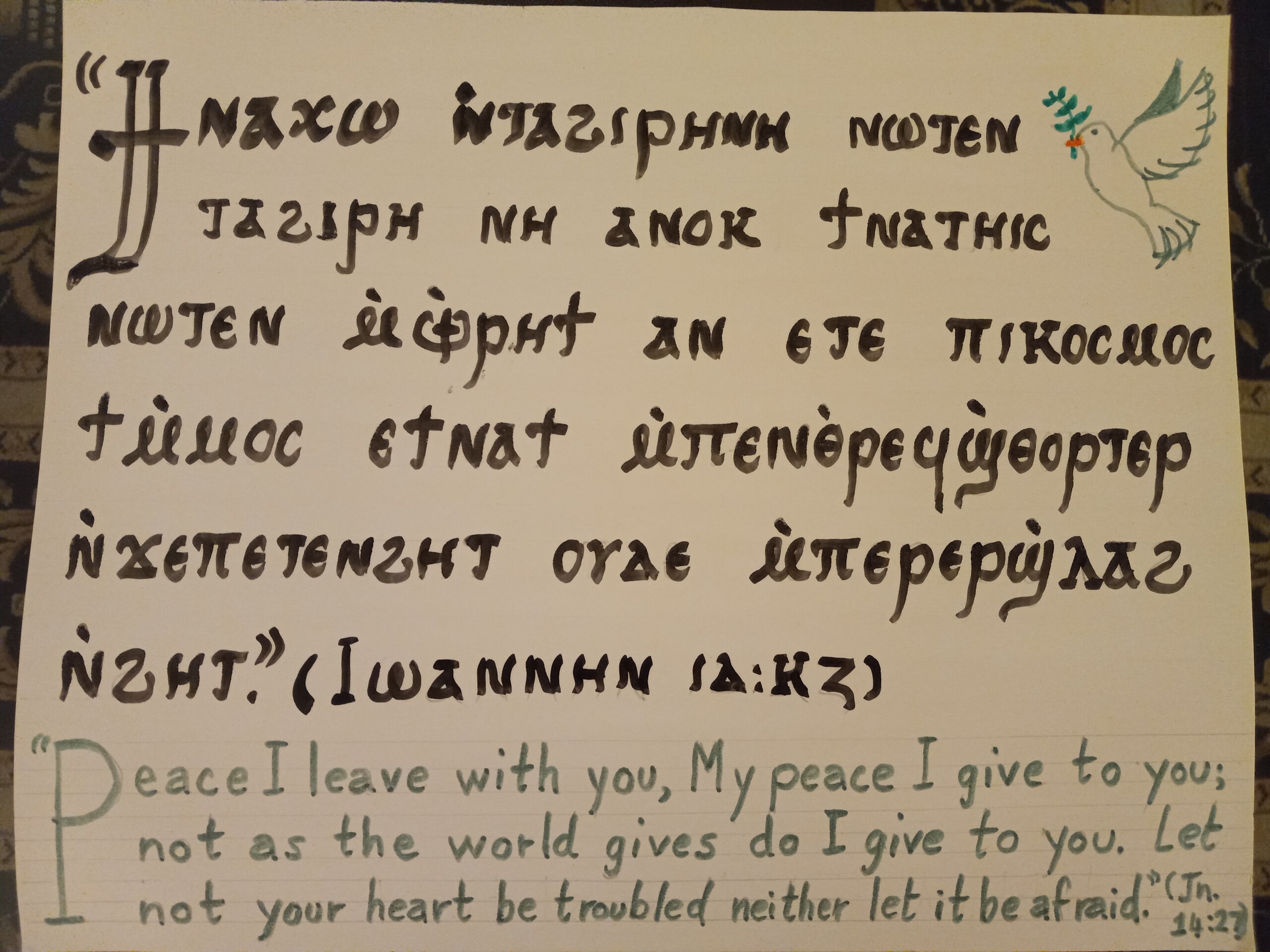
Coptic Calligraphy is an advanced level competition in Mahragan El-Keraza; enrollment and successfully competing in the core competitions is a prerequisite. The goal of the Coptic Calligraphy Competition is to encourage gifted Coptic children and Youth to integrate this form of art and creativity into spiritual fellowship and provide an opportunity for them to be recognized for their efforts. It is defined as the design and execution of Coptic lettering with a pen, ink brush, or other writing instrument with the intention of invoking an emotional feeling and to look beautiful.
GUIDELINES AND SPECIFIC DETAILS:
- The minimum age to participate in the photography competition is 4th Grade. The competition is open to the following age group categories:
- 4th & 5th Grade
- 6th – 8th Grade
- 9th – 12th Grade
- Adults
- One art piece limit per participant: A maximum of one calligraphy art piece is allowed per participant. The focus of the Coptic calligraphy submission has to be based on the Mahragan theme “we are more than conquerors through him who loved us (Romans 8:37)”. Pick a verse in the bible with the words “conqueror” or “love” in it and use Coptic calligraphy to write it down on paper or papyrus.
- Calligraphy Tools/Fountain pen, ball point or Gel pen can be used.
- Participants can use any Verse ( Or Church Fathers Saying) for Coptic Calligraphy, Length of paragraph should not exceed 130 words (shorter is better).
- Size, and Formatting: JPG, JPEG, or TIFF are the only allowed formats. Image quality and how it reflects the theme of the Mahragan will be considered when judging the work.
- Be Spontaneous and Creative: Participants are encouraged to be creative and spontaneous.
- Original Works only: Any work submitted must be original work and cannot include any work copied from external sources will automatically disqualify the participant.
- Include the following: Participants must describe the Verse or the Church Fathers’ saying.
- Evaluation Criteria: your work will be judged based on the following criteria:
- How does the picture match the Mahragan theme? 30%
- Quality of the Calligraphy 25%
- Creativity and Novelty 25%
- Uniformity and materials used 20%
- Deadlines and late submissions: Please submit (upload) your picture by 07/25/2026 using your Mahragan portal account. No late submissions will be allowed.
Samples from previous winners
Taraneem Writing & Music Composition (NEW)
Introduction to the competition
In the spirit of Jubal, the father of all who play the harp and flute, and in the footsteps of King David, who not only penned psalms but also orchestrated the musical worship, we are blessed to introduce the Taraneem Writing & Music Composition Competition to this year’s Mahragan. In this, we aim to inspire young Orthodox Christian youths in our diocese to express their faith and love for God through music and taraneem. This competition is designed to discover and nurture the talents of our youth, encouraging them to contribute their own songs and music to the rich tapestry of Orthodox Christian worship.
Eligibility and Entry Requirements:
Age Categories: Grades 1-3, 4-5, Middle School, High School, Adults
Submission Guidelines
- One Song Per Entry: Each participant may submit one song that includes both lyrics and music.
- Encouragement of Group Participation: We highly encourage group entries as they promote collaboration and creativity, with added points for teamwork.
- Opportunity for Dual Submissions: Participants in groups have the unique opportunity to also submit an individual entry. This encourages individual creativity within a collaborative setting. Please remember, no one is allowed more than one individual submission.
Theme:
The song’s lyrics must reflect the spirit of our Church, with a focus on this year’s theme, “we are more than conquerors through him who loved us (Romans 8:37)” Participants are encouraged to draw inspiration from the Bible, church fathers, or Orthodox hymnography.
Song Submission Guidelines:
Lyrics: Must present a Christian spiritual message, reflecting Coptic Orthodox Church teaching and spirit.
Music Composition: Participants are encouraged to submit original compositions. Additionally, the creative use of traditional taraneem / hymns with new arrangements, as well as the innovative implementation of traditional music tools such as cymbals and trianto, will be considered a plus.
Audio File Requirements: Submissions must be in MP3, WAV, or AAC format. The quality of the recording will be considered during the evaluation.
Documentation: A brief explanation of the song’s background, inspiration, and a description of any traditional elements used in the composition should be included.
***Special Interest In a cappella and vocal creativity: We hold a special interest in entries that showcase a cappella singing, where participants use their voices to create the entirety of the music, including melody, harmony, rhythm, and even mimicking instruments. This pure vocal art form will be given special attention and evaluated with a keen focus.
Evaluation Criteria:
- Adherence to Theme: 30%
- Lyric Quality (Wording, rhythm, use of verses and biblical content, theological depth, and Orthodoxy): 25%
- Musical Composition (Creativity, Originality, and Effective Use of vocals and tools): 25%
- Overall Presentation and Audio Quality: 20%
Notes:
- Multilingual Submissions: We accept and encourage submissions in multiple languages. Whether your song is in English, a mix of English and Arabic, Coptic, or any other language, we welcome the richness that different languages bring to taraneem. However, while we welcome songs in multiple languages, please note that English should be the primary language used. If your submission includes languages other than English, such as Arabic, Coptic, or others, we request that you provide a translation of the non-English lyrics in the song description. Please note that the choice of language(s) should serve the song’s goal and enhance its delivery and quality.
- Church Choirs Welcome: We extend a special invitation to church choirs to participate in our competition. In this case the choir members have to be in the same age group.
Submission Instructions:
-
Deadline: Ensure your submission is uploaded by 7/25/2026 through your Mahragan portal account.
-
Late Submissions: Will not be accepted.
Encouragement for Participants:
This competition is an opportunity for you to explore the depths of your faith and express it through music, whether through new compositions or by breathing new life into the timeless hymns of our faith. We are excited to see how you blend tradition with creativity, offering your unique contribution to the rich musical heritage of the Orthodox Church. Winning songs will be listed on the Church Sound Cloud.
Icon Reproduction or Icon-Inspired Art Competition
This competition invites participants to create hand‑drawn or hand‑painted icons or icon‑inspired art reflecting the Mahragan theme: “we are more than conquerors through him who loved us (Romans 8:37)”. Participants should select one saint or martyr whose life demonstrates perseverance, faith and spiritual victory.
GUIDELINES AND SPECIFIC DETAILS
Eligible Age Groups:
- 2nd – 3rd Grade
- 4th – 5th Grade
- 6th – 8th Grade
- 9th – 12th Grade
- Adults
Allowed Media & Format:
- One submission per participant; no digital art.
- Acceptable media: pencil, pen, marker, watercolor, acrylic, or mixed media.
- Size: between 8″×10″ and 11″×14″.
- Must include a title and the name of the selected saint.
Saints to Choose From (Pick One):
- St. George the Great Martyr : Called the “Prince of Martyrs” in the Coptic Church, St. George’s courage under torture and unwavering faith make him an enduring model of victory over fear.
- St. Demiana and the 40 Virgins : Known as the highest‑ranking female martyr of the Coptic Church, St. Demiana endured severe persecution and torture. Her steadfastness makes her an ideal example of conquering through faith.
- St. Mary of Egypt : After a life of sin, she repented, lived in the desert for forty years, and overcame temptations through God’s grace. Her story illustrates victory through repentance and divine love.
- St. Simon the Tanner : A humble cobbler whose faith moved the Mokattam Mountain when the Caliph demanded proof of the Gospel. He shows how humble faith conquers physical and spiritual obstacles.
- Anba Bishoy : A desert father renowned for his love and extreme asceticism; he merited visions of Christ and even carried Him. His life embodies victory over worldly desires through love and humility.
- St. Moses the Strong : Though last year’s list included him, his story of radical repentance and transformation from bandit to monk still powerfully conveys conquering sin and hatred through Christ.
Style and Iconographic Tradition:
Participants may either recreate a traditional Coptic icon of their chosen saint or create an original, icon‑inspired interpretation reflecting the saint’s life and the competition theme. Submissions must follow Coptic iconographic aesthetics (symbolic proportions, spiritual expression, theological depth); secular styles are ineligible. 6th grade and older may attach a 3–5 sentence reflection answering why they chose that saint and what they learned.
Generative Iconography option:
Concept: Participants use AI image generators (e.g., DALL·E, Midjourney, Stable Diffusion) to create art inspired by a specific Bible passage, saint, or feast. They then edit and refine the AI output by hand to ensure it aligns with Coptic iconographic aesthetics and theological accuracy. Editing the initial AI output can be either 1)digital (so the final icon is purely digitally made) or 2) by hand using the AI output base then editing it on a hard copy version.
Process: Contestants submit their original prompt(s), the AI‑generated image, and a final edited version. They must explain how they modified the AI output to reflect correct symbolism and theological meaning. Please make sure when submitting that the two images (original and modified) and shown side by side on the file submitted (do not submit 2 files!!). Use the comment section to explain how you modified the AI output.
EVALUATION CRITERIA
- Faithfulness to Coptic Iconographic Style 30%
- Creativity and Artistic Expression 30%
- Clarity and Effort 25%
- Relevance to Theme 15%
- Extra points will be given for icons painted on original materials such as wood, using oil or acrylic paints.
Extra points awarded for icons painted on traditional materials (e.g., wood) with oil or acrylic. All artwork must be uploaded via the Mahragan portal and submitted in person if selected as a winning icon by July 25, 2026. Late submissions are not accepted.
Instrumental Taraneem Competition
This competition invites participants to offer instrumental covers of beloved Coptic taraneem (spiritual songs) or hymns that reflect the Mahragan theme:
“we are more than conquerors through him who loved us (Romans 8:37). It is open to all participants who have competed in the core Mahragan competitions and are interested in expressing their faith through music.
It is allowed that more than 1 person participate in a submission (i.e. playing more than 1 instrument together).
GUIDELINES AND SPECIFIC DETAILS
Eligible Age Groups:
- 4th – 5th Grade
- 6th – 8th Grade
- 9th – 12th Grade
- Adults
Instruments Allowed:
- Any acoustic or digital instrument (e.g., guitar, oud, piano, violin, recorder, etc.). Voice is not permitted. Participants must create their own accompaniment.
- Backing tracks or accompaniment must be created by the participant—no karaoke-style background tracks allowed
Submission Format:
- One submission per participant
- Recordings must be submitted in mp4 or mp3 format, no longer than 4 minutes
- Maximum file size: 300 MB
- Must include the name of the tarneema/hymn in the submission title
- Encouraged qualities: Instrumental expression that conveys the emotion and message of the original hymn, clear melody with strong technique, and creative or unique arrangements.
Recommended Hymns and Taraneem for 2026
- First Canticle – “Song of Moses” (Crossing the Red Sea- Khen Oshot)
- Third Canticle – Hos Erof
- The Praise of the Three Holy Youths (within the Third Canticle)
- Psali of the Cross (إبصالية الصليب)
- Any other well‑known Coptic hymn aligned with the theme : Participants may choose additional traditional taraneem that celebrate faith, perseverance and spiritual identity, provided they are not the same pieces used last year. Examples include hymns honouring saints who overcame suffering, or other doxologies and psalms of victory.
EVALUATION CRITERIA:
- Musical Quality and Technique – intonation, timing and control. 25%
- Clarity of Melody – the tune should remain recognisable and clear. 20%
- Creativity in Arrangement – originality while respecting the hymn’s spirit. 20%
- Faithfulness to Theme and Spiritual Impact – how well the piece reflects “more than conquerors through Him who loved us.” 20%
- Effort and Presentation – overall polish, including audio quality and file labelling. 15%
All files must be submitted online (through the Mahragan portal online) by July 25, 2026. Each submission should include the title of the tarneema or hymn. Late submissions will not be accepted.